


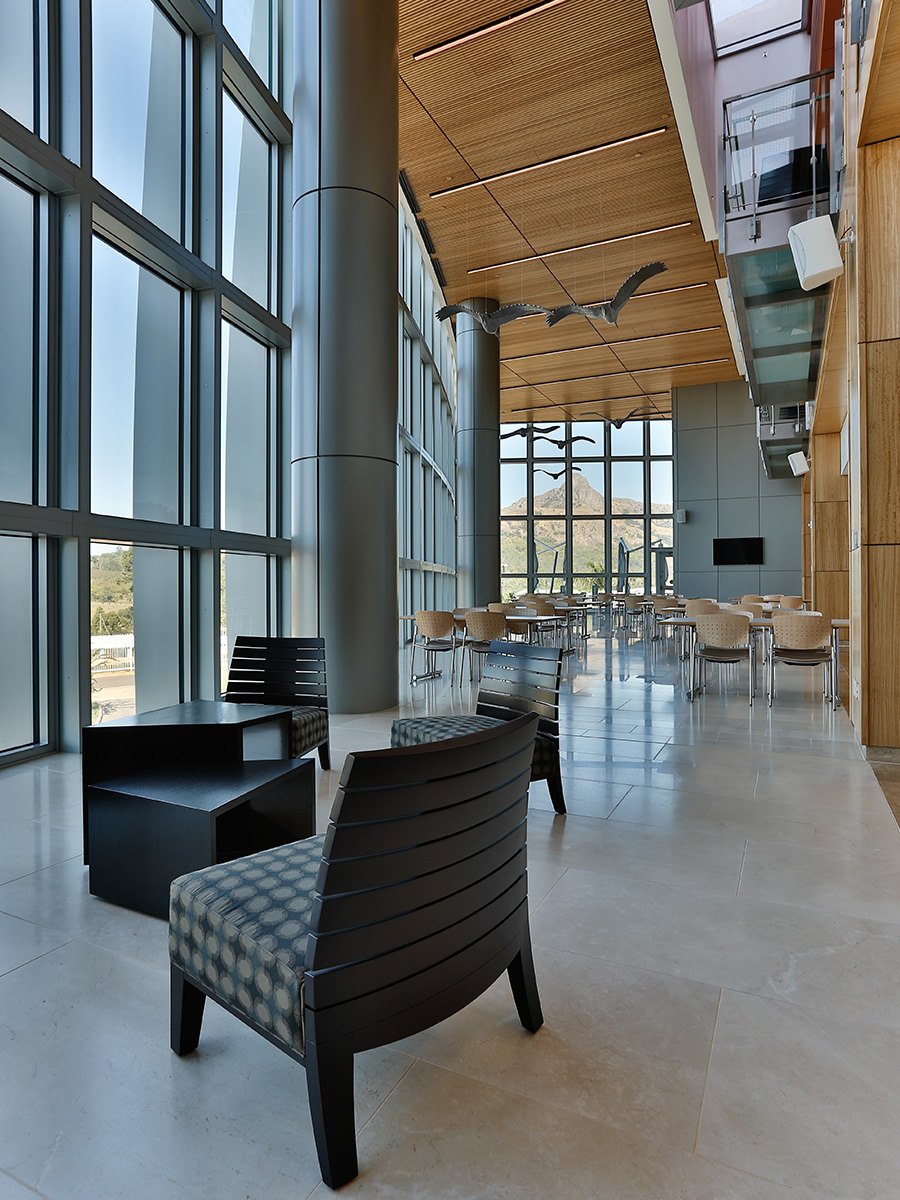
In addition to minimizing solar gain, the building’s orientation with the curved gallery glazing wall directs toward the site’s primary view—the Execution Rock Mountain peak. Three stories in height, the curtain wall obscures the boundary between the exterior and interior and increases the impact of the adjacent lobby, atrium, and cafeteria.

US Embassy
Mbabane, Eswatini
The design of the new US Embassy in Mbabane is inspired by the rich history of agriculture, textures, and patterns that blanket the landscape surrounding the Ezulwini Valley.
KCCT led a sustained and iterative design process to design the new compound on a 3.6-hectare site. Local ecology and culture were incorporated into the design and factored particularly heavily into the landscape architecture. The steeply sloped site leads to a terraced layout, which harmonizes the landscaping with the surrounding agricultural terracing and takes advantage of the natural grades.
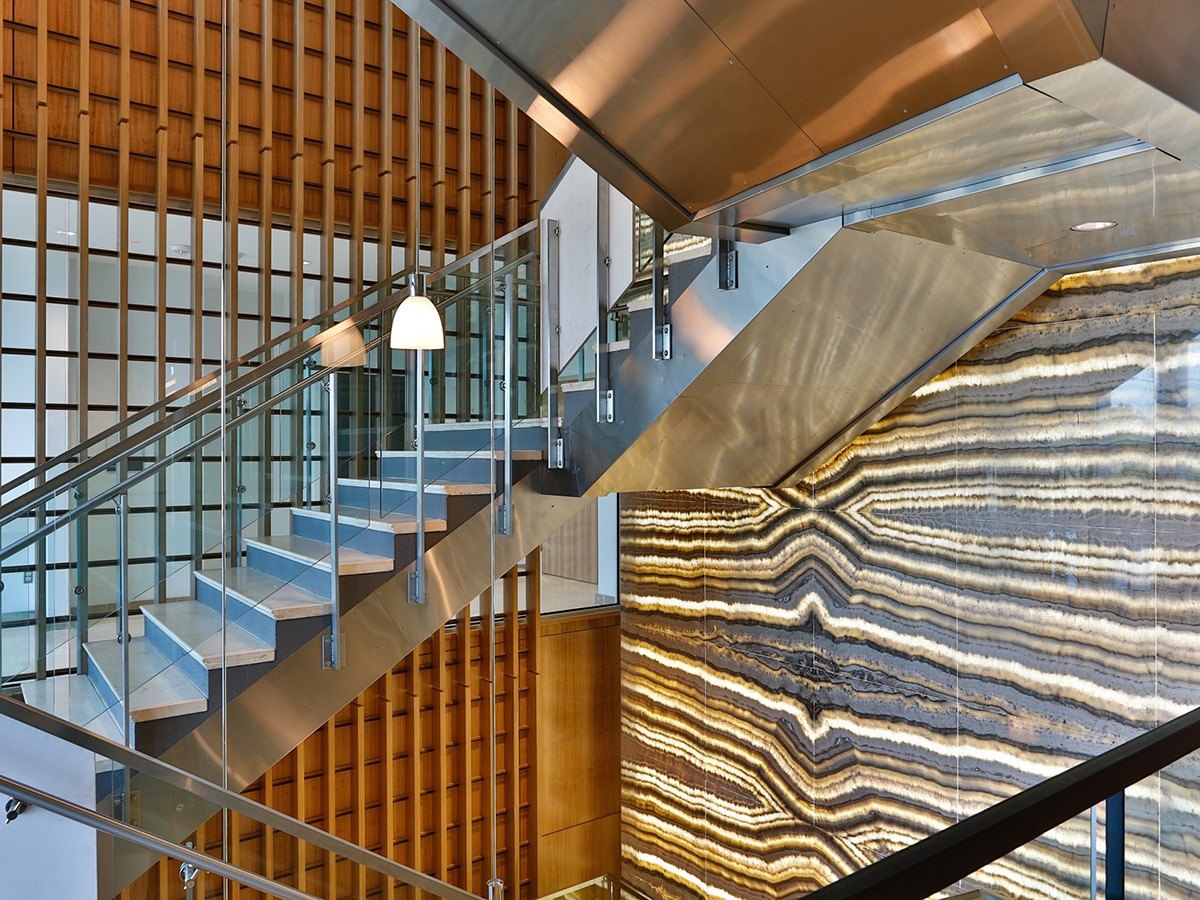
Monumental stair within the new office building
Design Approach
The four-story new office building presents a single terracotta mass with regular punched windows, contrasted by a dramatic curved gallery space shaped by a straight segmented glazing system. Sunshade fins on the curtain wall help reduce glare and minimize solar gain. High-performance interiors strategies such as open workspaces and open kitchen and support areas contribute to a more collaborative environment. The narrow floor plate oriented east-west for solar control maximizes natural light and views for the occupants.
Program Objectives
Responding to unique site and environmental opportunities, KCCT designed an economical, compact, energy-efficient building supplemented by glazed projections focused on prominent landscape features. The design prioritizes resource efficiency, water and energy conservation, and indoor light and air quality. The 100 kW photovoltaic solar power plant reduces demand on the local power grid and operating cost to the embassy. LED site lighting and indoor occupancy sensors reduce energy use, all measures that coalesce to optimize energy performance and cut operational costs.

The Embassy balances openness, collaboration, and security. Interiors are designed to facilitate interaction through open floor plans, flexible workspaces, and communal areas. Security requirements are seamlessly incorporated without compromising transparency or accessibility. The design successfully co-locates previously separate mission functions, incorporates security requirements vital to the safety of occupants, and is responsive to the local environment and culture while reflecting the relationship between the United States and Eswatini (then Swaziland).
Project Information
Services
Location
Mbabane, Eswatini
Size
101,940 SF
Owner
US Department of State Bureau of Overseas Buildings Operations
Related Projects


